
NYCECC 2025: What New York City’s New Energy Code Means for Buildings
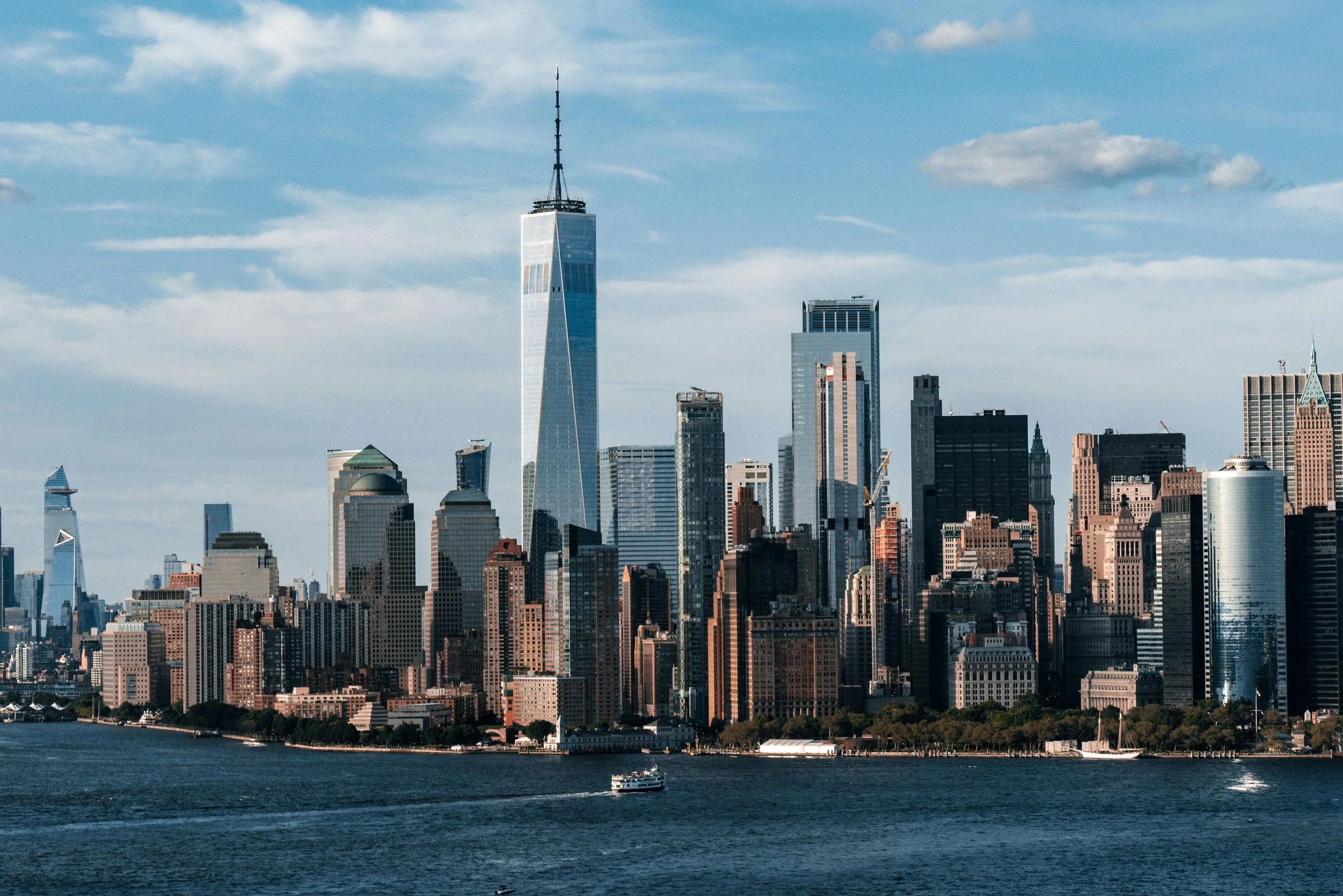
NYCECC 2025 - Effective March 30, 2026
New York City has officially adopted the 2025 New York City Energy Conservation Code (NYCECC 2025)—one of the most substantial updates to local energy requirements in recent years. Based on IECC 2024 and ASHRAE 90.1 2022, with additional NYC specific amendments, the new code is more stringent than the 2025 NY State Energy Code (ECCCNYS) and is designed to accelerate efficiency, electrification, and longer-term carbon reduction across the city’s building stock.
For building owners, architects, engineers, and project teams, early understanding of these changes is essential. This summary highlights the most important updates and how they may affect design, renovation, and compliance strategies moving forward.
Why NYCECC 2025 Matters
The updated energy code supports several of New York City’s long‑term climate and building‑performance goals. It aims to improve building energy performance, reduce greenhouse gas emissions, support cleaner and electrification‑ready systems, align more closely with Local Law 97 and future carbon regulations, and strengthen the resilience and efficiency of the city’s buildings. The sections below provide a high‑level overview of the major changes across building envelopes, lighting, HVAC, water heating, renewables, monitoring, and compliance pathways.
Overview of the Key Changes in NYCECC 2025
1. Existing Buildings: Historic Structures Are No Longer Exempt
Historic and landmarked buildings must now comply with the energy code unless they receive an exemption through a formal Historic Building Report.
Only documented features identified as character‑defining may qualify for special consideration.
2. Thermal Bridging Requirements Expand
NYCECC 2025 puts stronger attention on thermal performance. Projects must now:
Provide thermal bridging calculations for proposed designs
Address thermal impacts of columns, beams, slabs, parapets, and structural members
This will require more detailed envelope modeling and improved continuity of insulation.
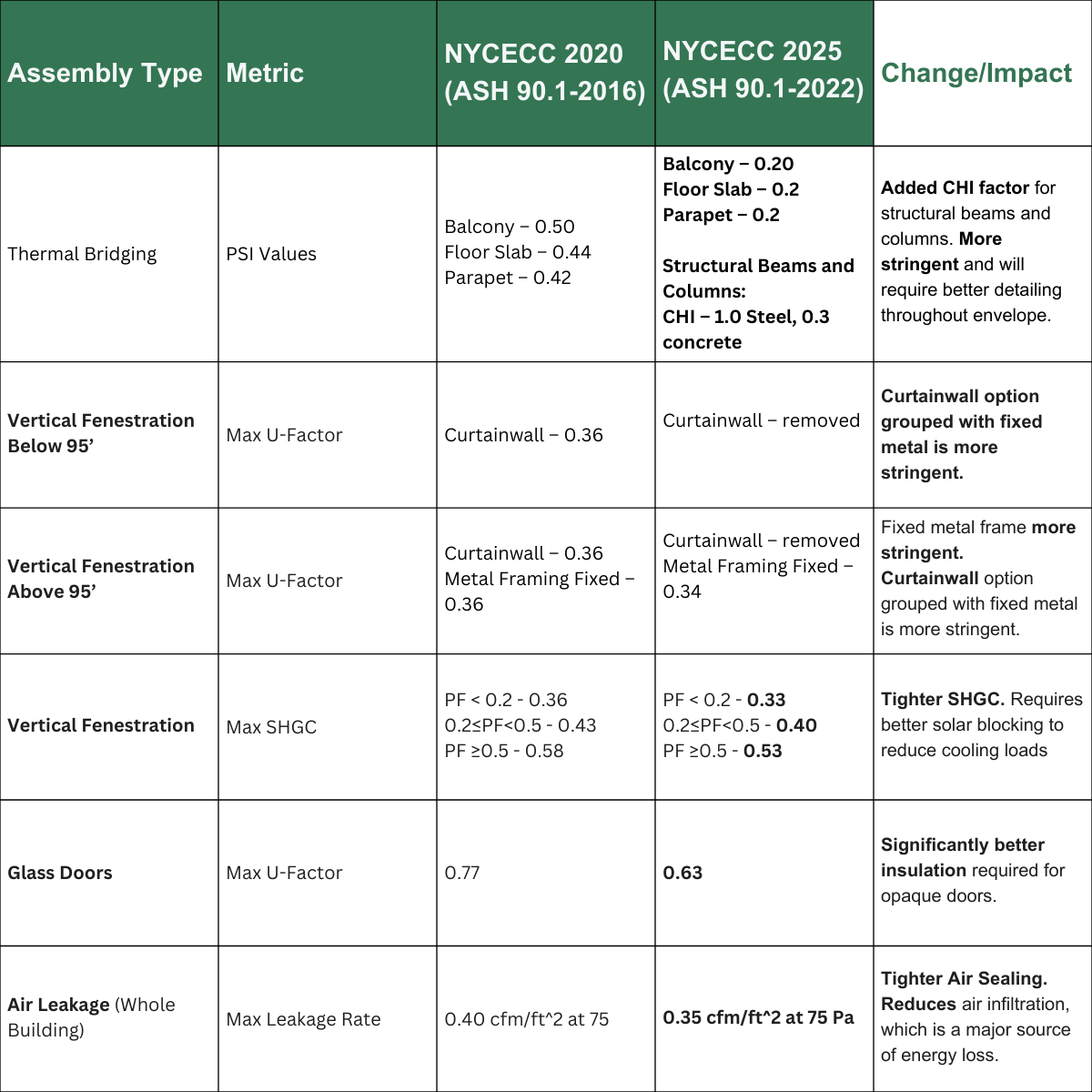
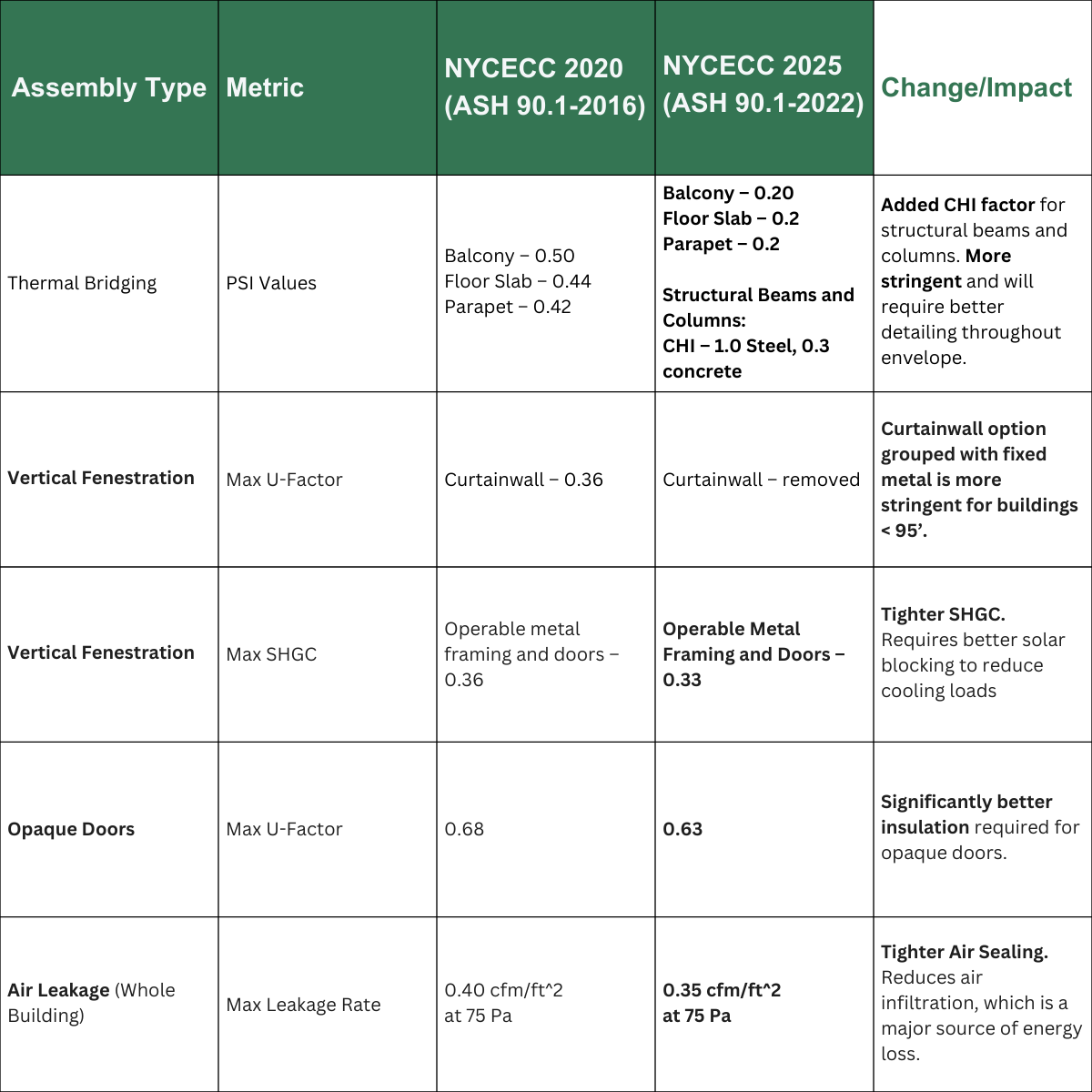
3. Fenestration & Door Requirements Increase
The code introduces improved minimum performance requirements for:
Curtainwalls
Doors in residential and nonresidential spaces
Fenestration in semi‑heated spaces
Solar heat‑gain control across glazing systems
Expect stricter U‑factor and Solar Heat Gain Coefficient (SHGC) thresholds.
See tables IECC and 90.1 (APPENDIX CA)
4. Lighting and Lighting Controls: LPDs Reduced 15–30%
Most commercial interior space types will see significant reductions in allowable Lighting Power Density (LPD).
Examples of Updated Interior LPD Requirements
Open plan: 0.78 → 0.56 W/sf
Enclosed office: 0.85 → 0.73 W/sf
Retail: 1.06 → 0.85 W/sf
Conference room: 0.93 → 0.88 W/sf
Corridor: 0.58 → 0.44 W/sf
Control Requirements Also Expand
More occupancy‑based controls
Daylight‑responsive controls (threshold lowered from 100W to 75W)
New demand‑response lighting functionality
~5% reduction for most exterior lighting applications
These updates will require early coordination between lighting designers, architects, and electrical teams.
5. Receptacle Controls
New York City requires automatic receptacle controls for offices, classrooms, and conference rooms.
NYC may remove or revise this section, pending final confirmation.
6. HVAC System Efficiency and Electrification
NYCECC 2025 includes comprehensive updates across HVAC system design:
Higher efficiency requirements for heat pumps, VRF systems, and chillers
Stronger performance requirements for energy recovery systems
Air‑side heat recovery now required in dwelling units
Stricter terminal unit control requirements (occupancy, vacancy, demand response)
Better boiler efficiency standards for large condensing systems
Electric resistance backup heat limited to 25% of design load, allowed only below 17°F
These changes collectively push the market toward more efficient, electric‑ready systems.
7. Water Heating
Increased efficiency benchmarks
Encourages heat pump water heating and electric‑ready design
8. Renewable Energy Requirements for New Buildings
New buildings must include on‑site renewable energy at 0.75 W/sf of gross building area unless exempt.
If on‑site installation is not feasible:
Off‑site renewable energy may be procured at 15× the on‑site equivalent
Acceptable through a PPA or community renewable energy facility
9. Energy Monitoring
Projects must implement expanded end‑use energy monitoring, breaking down:
Electrical energy use by system type
Fuel energy use by end‑use category
This supports future compliance tracking and operational efficiency.
10. Energy Compliance Pathways: More Credits Required
Performance‑based compliance becomes more stringent under NYCECC 2025.
Efficiency credit requirements vary by building type and now include:
Mandatory renewable energy and/or load management credits
More complex scoring requirements for different project types
Examples:
New Construction – Multifamily
86 total points required
31 must be renewable/load management
Sample credits:
Window performance improvement: +22
Domestic hot water flow reduction: +38
Hot water storage load management: +19
Battery storage: +16
New Construction – Office
70 total points required
44 must be renewable/load management
Sample credits:
UA reduction (15%): +13
Point‑of‑use water heaters: +20
Lighting power reduction: +7
Occupancy sensor dimming: +12
Lighting load management: +10
HVAC load management: +12
Office Fit‑Out > 1,000 sq.ft.
With HVAC/DHW upgrades → must meet 50% of office credit requirement
Without HVAC/DHW upgrades → must meet 33% of office credit requirement
What NYCECC 2025 Means for Building Owners and Design Teams
The 2025 New York City Energy Conservation Code (NYCECC) introduces more rigorous expectations for building performance across almost every category. Starting in 2026, all renovations, system upgrades, and tenant improvement projects will be required to meet these heightened standards. Owners and design teams should begin preparing now to get ahead of these new requirements.
At CodeGreen, our team plays an active role in shaping and interpreting the energy and sustainability standards that guide the real estate industry. This experience enables us to help project teams navigate the complexities of NYCECC 2025, integrate new requirements seamlessly into project planning, and support long‑term compliance and high‑performance outcomes.
Meet the sustainability team at CodeGreen



envelope REQUIREMENTS TABLE - IECC
ENVELOPE REQUIREMENTS TABLE - 90.1 (APPendix CA)
* Historic building report
For features and/or systems that intend to apply for exemption from energy code compliance, the following guidance is provided in NYCECC 2025. Such report(s) must be provided with the energy compliance documentation during the filing process.
Section C501
… C501.5.1 Historic building report. Written historic building reports shall be signed by a registered design professional or a representative of the State Historic Preservation Office or the historic preservation authority having jurisdiction. Such reports shall identify each feature that is a character-defining feature of the historic form, fabric, or function of such historic building or historic district and shall demonstrate that compliance with a specific provision or provisions of this code would threaten, degrade or destroy the historic form, fabric or function of the building or historic district.