
FISP (Local Law 11/98): What Building Owners Need to Know for Cycle 10
New York City’s FISP (Local Law 11/98), also known as the Façade Inspection and Safety Program (FISP), is a critical compliance requirement for building owners. Applicable to buildings over six stories, the law mandates periodic façade inspections performed by a Qualified Exterior Wall Inspector (QEWI) to ensure exterior walls and appurtenances are safe and properly maintained. Following the inspection, a report must be submitted to the NYC Department of Buildings for approval.
As Cycle 10 continues, early planning and expert guidance are more important than ever to avoid delays, penalties, and unexpected repair costs.
Understanding FISP (Local Law 11/98) Cycle 10
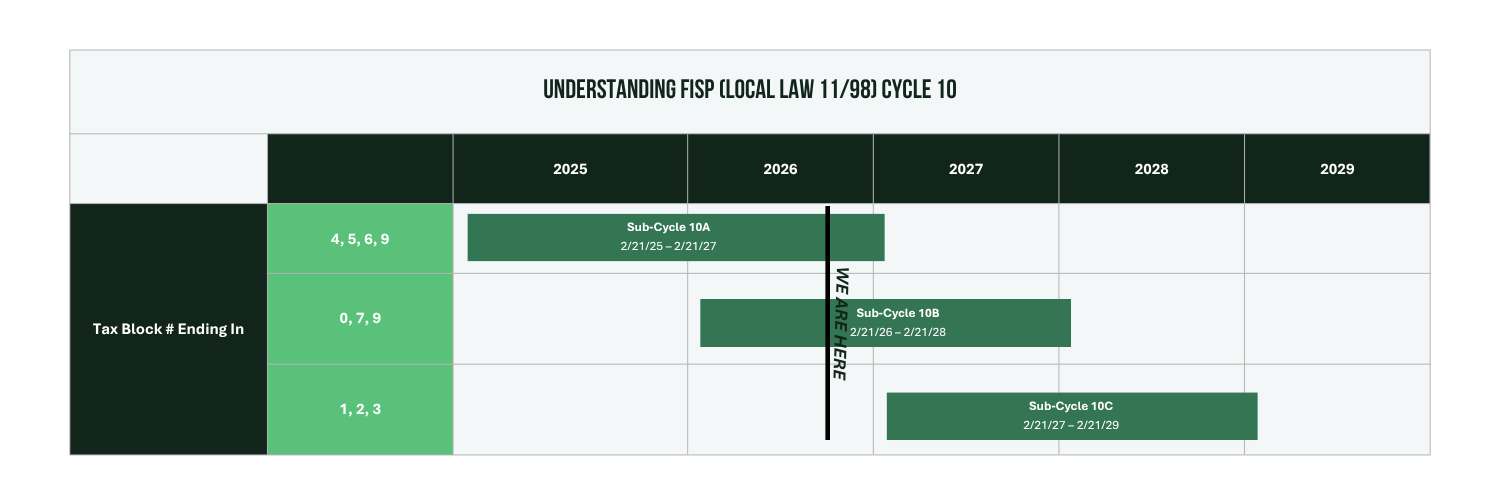
While these windows may seem generous, filing timelines can quickly tighten due to inspection backlogs, design coordination, and repair scopes. Advance planning is strongly recommended to maintain flexibility and avoid last-minute challenges.
Addressing Outstanding Prior Cycle Conditions
Buildings with unresolved conditions from previous cycles must address them prior to submission of the Cycle 10 report. This includes properties that were previously filed as:
SWARMP (Safe With a Repair and Maintenance Program)
Unsafe
Filed Late
No Previous Filing / Missed Cycle
Failing to resolve prior cycle issues can lead to serious consequences, including:
Mandatory installation of public protection
DOB violations
Civil penalties
Increased repair costs
Emergency repair conditions
Filing delays or rejection
A proactive review of prior filings is essential to prevent these risks and streamline the Cycle 10 process.
How CodeGreen Can Help
CodeGreen provides full-FISP (Local Law 11/98) support, from inspection through repairs. We help building owners address conditions from prior cycle efficiently and confidently. Our team not only advises and prepares compliance strategies, but also performs hands-on close-up inspections, evaluates existing conditions, and actively supports the execution of required repairs. This comprehensive, field-driven approach allows us to provide clients with clear, practical guidance on repair priorities, realistic construction timelines, and upcoming DOB filing deadlines. By managing the process from assessment through resolution, CodeGreen delivers continuity, accountability, and technical precision at every stage, giving building owners clarity and confidence in achieving and maintaining compliance.
Previous Cycle Review
Review of prior FISP (Local Law 11/98) filings
Evaluation of SWARMP and Unsafe conditions
Identification of outstanding repair items
FISP Inspection and Assessments
Performs hands-on up close inspection and condition assessments
Detailed documentation of deficiencies
Repair Design & Engineering
Preparation of scope of work, repair drawings, and project specifications
DOB filing support
Assistance with contractor bidding and procurement
Construction Administration
Performs close-up inspections of façade repair conditions and tracks the progress following each inspection
Includes Construction document preparation and NYC Department of Buildings and LPC filing support as required
Cycle 10 DOB Filing Support
Preparation and submission of the FISP Cycle 10 report, and coordination with the NYC Department of Buildings as necessary
Filing preparation and submission
Preparation and coordination of final documentation in accordance with FISP (Local Law 11/98) requirements. Codegreen can help our clients Plan Early to stay compliant.
FISP (Local Law 11/98) compliance is not just a regulatory requirement—it is an opportunity to protect occupants, preserve asset value, and reduce long-term risk.
With deep expertise in building enclosure systems, façade restoration, and regulatory compliance, CodeGreen partners with owners, managers, and design teams to deliver durable, compliant, and cost-effective solutions.
If your building is currently in, or approaching its FISP (Local Law 11/98) Cycle, now is the time to prepare.